







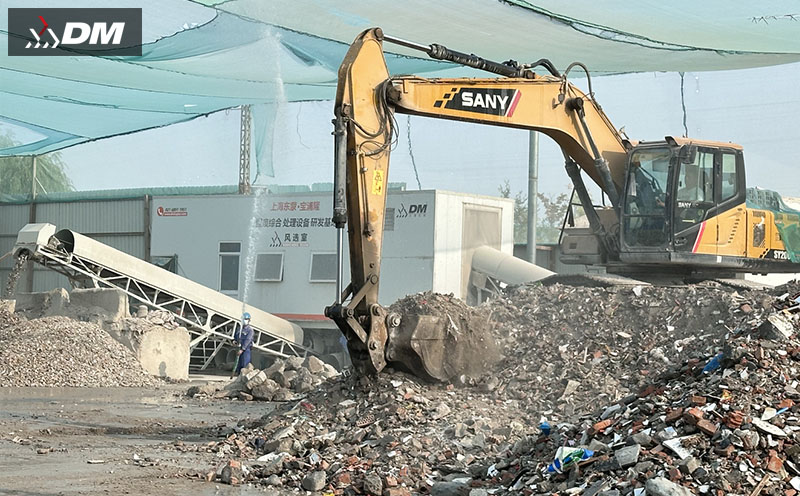
As Africa's economic engine, South Africa generates massive and diverse waste in the rapid development of mining, construction, and manufacturing industries—annual mining tailings emissions exceed 120 million tons, daily construction and demolition (C&D) waste output exceeds 6,000 tons, and the cumulative stock of industrial waste residues (metallurgical slag, gangue, etc.) reaches 500 million tons. Traditional disposal methods are dominated by landfilling and open-air stacking, which not only occupy over 3,000 hectares of land but also cause environmental problems such as soil heavy metal pollution, groundwater leakage, and dust diffusion. This is significantly inconsistent with the target of "40% waste resource recycling rate by 2030" in South Africa's National Circular Economy Strategy. Focusing on South Africa's waste disposal pain points, DongMeng has tailor-made an integrated waste solution featuring "multi-category adaptation, resource recycling, and environmental compliance." Through crushing, sorting, and purification technologies, it converts mining tailings, C&D waste, and industrial residues into high-value renewable resources, solving environmental problems while creating substantial economic benefits for enterprises, and becoming a "core enabler" of South Africa's circular economy development.
Core Value: Win-Win of Environmental Protection and Profits, Activating Circular Economy Potential
DongMeng's waste solution is not a single disposal equipment, but a full-chain service covering "waste classification - crushing - sorting - purification - recycling." It realizes the triple value of "environmental pollution reduction, resource appreciation, and enterprise efficiency improvement" through resource recycling, accurately matching South Africa's industrial needs.
1. Multi-Category Waste Adaptation: One-Stop Processing, Covering All Scenarios
The system has strong compatibility and can efficiently handle mainstream waste types in South Africa: ① Mining tailings (gold, platinum, iron ore tailings): Through combined gravity separation + magnetic separation technology, recover valuable minerals such as gold, platinum, and iron remaining in tailings (recovery rate ≥90%), and the remaining tailings are crushed and screened to produce recycled aggregates; ② Construction and demolition waste (concrete blocks, bricks, steel bars): Separate impurities via AI visual sorting + magnetic separation, producing recycled aggregates of 0-5mm and 5-20mm specifications, complying with South Africa's SANS 1083 construction standard; ③ Industrial residues (metallurgical slag, gangue): Convert into road base materials, cement admixtures, or new building materials through high-temperature stabilization + crushing and purification processes; ④ Urban mixed waste: Separate recyclables and non-recyclables through a multi-level sorting system, increasing the resource recycling rate to over 85%. At a comprehensive waste treatment center in Gauteng Province, one system processes 300 tons of mixed waste daily with a resource recycling rate of 88%, far exceeding the local average (55%).
2. Environmental Compliance: Full-Process Pollution Reduction, Meeting South African Standards
Strictly adhering to South Africa's DEFF (Department of Environment, Forestry and Fisheries) environmental standards, the system achieves "zero pollution and low emissions" through full-process environmental design: ① The crushing link is equipped with pulse bag filters + enclosures, with dust emission concentration ≤10mg/m³, far below South Africa's limit of 15mg/m³; ② Wastewater treatment adopts a closed-loop system of "sedimentation - filtration - reverse osmosis," and the treated water meets reuse standards, 100% used for equipment cooling and raw material cleaning without external discharge; ③ Heavy metals in tailings and residues are treated through chemical stabilization with a solidification rate ≥95% to avoid soil pollution; ④ Operating noise ≤80dB(A), combined with sound insulation enclosure design, meeting the operation requirements of sensitive areas such as mining areas and urban areas. All projects have passed environmental compliance acceptance by South African authorities.
3. High-Value Resource Recycling: Turning Waste into Treasure, Creating Considerable Profits
Renewable resources produced by the system cover multiple application scenarios, bringing sustained economic returns to enterprises: ① Recycled aggregates: Used for road construction, affordable housing masonry, and concrete mixing station blending, with a price 30%-50% lower than natural aggregates. After adopting recycled aggregates in a road renovation project in Johannesburg, the material cost was reduced by 40%; ② Recovered valuable minerals: Precious metals such as gold and platinum recovered from mining tailings can increase annual revenue for mines by over one million Rand; ③ Recycled industrial residue products: Road base materials made from metallurgical slag have a compressive strength of C40 standard, supplied to South African highway projects with a unit price 15% higher than traditional materials; ④ Recyclables purification: Separated steel bars, plastics, and wood are processed for secondary sales, forming an additional revenue chain. At a gold mine tailings treatment project in the Western Cape, the system recovers 20kg of gold and 5kg of platinum annually, while producing 150,000 tons of recycled aggregates, with a comprehensive annual revenue exceeding 8 million Rand.
4. Flexible Deployment Adaptation: Combined Mobile + Fixed Modes, Adapting to Different Scenarios
Targeting the scattered waste generation points (mining areas, urban areas, industrial zones) in South Africa, two deployment modes are provided: ① Fixed solution: Suitable for large-scale waste treatment centers and centralized mine tailings ponds, adopting modular complete sets of equipment with a daily processing capacity of 500-1500 tons and a long stable operation cycle; ② Mobile solution: Equipped with a crawler chassis, it can directly reach mining areas, demolition sites, and waste stockpiles, with rapid commissioning within 2-4 hours and a daily processing capacity of 100-300 tons, featuring flexible relocation. At a remote mining area in the Northern Cape, the mobile system processes tailings on-site, shortening the transportation distance by 80km and reducing transportation costs by 60%.
Technical Core: Precise Empowerment, Ensuring Resource Recycling Efficiency and Stability
Targeting the characteristics of South African waste such as "complex composition, uneven hardness, and high impurity content," the system achieves operational guarantees of "efficient processing, stable operation, and easy maintenance" through core technology optimization.
1. Intelligent Sorting and Purification Technology: Precise Separation, Enhancing Resource Value
- AI Vision + Multi-Level Sorting: Equipped with high-definition cameras and AI recognition algorithms, identifying impurities and valuable components in waste within 0.3 seconds, with sorting accuracy exceeding 95% in conjunction with magnetic separation, gravity separation, and air separation equipment;
- Heavy Metal Stabilization Technology: Adopting chemical chelation + high-temperature solidification processes to convert heavy metals in tailings and residues into stable compounds, avoiding secondary pollution;
- Aggregate Purification System: Removing dust and soil from recycled aggregates through cleaning + screening + classification processes, ensuring uniform particle gradation and a crushing value ≤18% to meet high-grade application requirements.
2. Efficient Crushing System: Adapting to High-Hardness Waste, Low-Loss Operation
- Combined Crushing Process: Adopting "jaw crusher + impact crusher" (medium-low hardness, such as C&D waste) or "jaw crusher + hydraulic cone crusher" (high hardness, such as mining tailings, metallurgical slag) combinations according to different waste hardness, increasing crushing efficiency by 25%;
- Wear-Resistant Component Upgrade: Core liners and jaw plates are made of high-chromium-molybdenum alloy (Cr25Mo5) with a hardness of over HRC62, extending service life by 70% compared to ordinary components and reducing maintenance costs;
- Anti-Clogging Design: The crushing chamber is equipped with a high-frequency vibration device to avoid wall adhesion and clogging for high-moisture waste (such as C&D waste in the rainy season), maintaining a screening efficiency of over 90%.
3. Localization Adaptation Optimization: Matching South African Working Conditions, Convenient Operation and Maintenance
- Environmental Adaptation: The electrical system adopts IP65 protection rating, equipped with a forced ventilation cooling system, withstanding South Africa's 40℃ high temperature and 85% high humidity environment, with an equipment failure rate ≤3%;
- Spare Part Versatility: Common spare parts (liners, screens, filters) adopt standardized design, compatible with South Africa's local supply chain, shortening the procurement cycle to within 7 days;
- Multilingual Operation: The central control screen supports bilingual operation in English and Afrikaans, equipped with a remote fault diagnosis system, allowing technicians to solve 80% of common problems online and reducing on-site operation and maintenance needs.
South African Project Cases: Practical Verification, Activating Circular Economy Value
DongMeng's waste solution has been implemented in multiple projects in South Africa's mining, construction, and environmental protection industries, gaining customer recognition for significant environmental and economic benefits.
Case 1: Western Cape Gold Mine Tailings Treatment Project — Resource Recovery + Tailings Utilization
The project needs to handle 2 million tons of annual tailings from a gold mine, with traditional open-air stacking. After commissioning DongMeng's fixed waste solution: ① Recover 20kg of gold and 15,000 tons of iron concentrate annually through gravity separation + magnetic separation technology, directly creating 6 million Rand in revenue; ② The remaining tailings are made into recycled aggregates, supplied to surrounding highway construction projects with an annual sales volume of 180,000 tons and revenue exceeding 2 million Rand; ③ Dust emission concentration is 8mg/m³, and wastewater is 100% reused, passing DEFF environmental acceptance and becoming a demonstration project for tailings resource recycling in South Africa.
Case 2: Johannesburg C&D Waste Recycling Project — Urban Renewal + Resource Circulation
The old urban area renewal project in Johannesburg generates 200 tons of C&D waste daily, processed on-site by DongMeng's mobile solution: ① Rapid commissioning within 2 hours, separating steel bars (recovery rate 98%), plastics, and other impurities via AI visual sorting + magnetic separation; ② Producing 150 tons of recycled aggregates daily, supplied to surrounding affordable housing projects, reducing material costs by 40% and overall project cost by 12%; ③ Reducing landfilling by 15 mu annually and carbon emissions by 1,800 tons, winning the "Green Project" certification from the City of Johannesburg.
Case 3: Gauteng Industrial Residue Utilization Project — Industrial Emission Reduction + Building Materials Innovation
A steel plant produces 500,000 tons of metallurgical slag annually, with stacking causing soil pollution. After commissioning DongMeng's solution: ① Convert metallurgical slag into road base materials and cement admixtures through high-temperature stabilization + crushing and purification processes; ② Process 450,000 tons of metallurgical slag annually, producing 350,000 tons of recycled building materials supplied to South Africa's N1 highway renovation project, with revenue reaching 3.6 million Rand; ③ Reduce waste stacking by 80 mu, with a heavy metal solidification rate of 97%, helping the enterprise complete environmental rectification and avoid heavy fines.
Empowering South Africa's Circular Economy: Activating New Drivers of Green Growth with Technological Innovation
South Africa is in a critical stage of circular economy development, and waste resource recycling has become a core path to address environmental pressures and enhance industrial competitiveness. With "multi-category adaptation, high-value utilization, and environmental compliance" as the core, DongMeng's waste solution converts "waste" into "new resources" through technological innovation, helping enterprises reduce environmental costs, create additional revenue, and assisting South Africa in achieving strategic goals of land conservation, pollution reduction, and resource circulation.
DongMeng has always been deeply rooted in the South African market, adhering to the principles of "localization adaptation, full-chain service, and sustainable development," continuously optimizing solutions from fixed to mobile modes, and from single-category to full-category processing, comprehensively meeting the waste disposal needs of different industries and scenarios in South Africa. In the future, DongMeng will continue to take technological innovation as the engine, work with South African enterprises and the government to activate the economic and environmental value of waste, help South Africa build a circular economy closed-loop of "resources - products - waste - renewable resources," and inject lasting momentum into green and sustainable development.
If you would like to get help immediately, you can also fill your requirements on the following form, we will contact you on the right time.


Get In Touch