







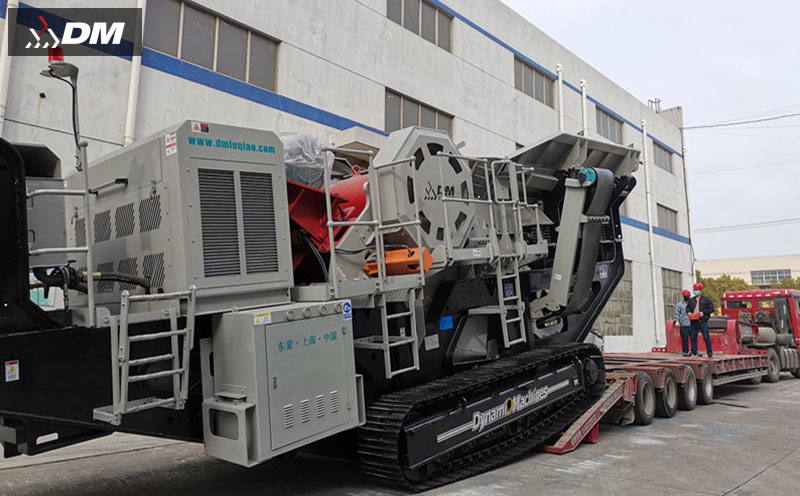
Africa, home to the world’s richest reserves of minerals and construction aggregates—from South Africa’s gold and the Democratic Republic of the Congo’s cobalt to East Africa’s granite—these valuable resources are the core driver of Africa’s industrialization and economic takeoff. However, for a long time, Africa’s crushing industry has been plagued by pain points such as low efficiency, high energy consumption, difficult operation and maintenance, and heavy reliance on manual labor. Traditional crushing equipment and models struggle to meet the large-scale demands of resource development. Today, with the penetration of technologies such as artificial intelligence, the Internet of Things, and automated control, intelligent crushing solutions are bringing revolutionary changes to Africa’s mining and infrastructure sectors. With their advantages of precision, efficiency, and low carbon emissions, they unlock resource value and forge a path of glory for Africa’s development.
I. Pain Points of Africa’s Crushing Industry: Bottlenecks and Challenges of Traditional Models
The development predicament of Africa’s crushing industry stems from numerous limitations of traditional models. Firstly, the level of equipment automation is low—most mines and quarries still rely on manual operation, which is not only inefficient but also exposes workers to safety risks from harsh environments such as high temperatures, heavy dust, and intense vibration. The shortage of skilled technicians further exacerbates production pressures. Secondly, energy consumption and wear issues are prominent. Traditional crushing equipment lacks intelligent adjustment functions and cannot optimize operating parameters when processing materials of varying hardness and particle size, leading to severe energy waste. At the same time, equipment is prone to breakdowns due to overload and wear, resulting in high maintenance costs and prolonged downtime.
Additionally, weak infrastructure in some parts of Africa—such as inconvenient transportation and unstable power supply—poses significant challenges to equipment transportation, installation, and continuous operation. The lack of data management makes it difficult for managers to grasp real-time production progress, equipment status, and energy consumption, leading to widespread decision-making delays. These pain points severely restrict the efficiency and sustainability of Africa’s resource development, creating an urgent need for an intelligent solution that adapts to local conditions while balancing practicality and advanced technology.
II. Intelligent Crushing: Technology Empowers, Reconstructing Africa’s Crushing Ecosystem
Centered on "technology integration + precise adaptation," intelligent crushing solutions address the industry’s pain points in Africa by building a full-chain intelligent system from equipment to management, completely transforming the traditional crushing model.
At the core equipment level, intelligent crushers are the main driver of change. Mobile crushing stations equipped with AI algorithms can real-time collect data on material hardness and particle size through sensors, automatically adjusting parameters such as crushing chamber gap and rotational speed to achieve "material-adaptive" crushing. This not only improves crushing efficiency and qualified rate of finished materials but also reduces equipment wear and energy consumption. For example, facing Africa’s diverse types of ore, intelligent cone crushers can accurately identify material characteristics and switch crushing modes, avoiding resource waste and equipment damage caused by the "one-size-fits-all" approach of traditional equipment. Meanwhile, the equipment integrates remote control modules, allowing operators to remotely start/stop the equipment and adjust parameters from safe ground areas or via mobile apps, completely freeing them from harsh working environments.
The Internet of Things (IoT) and data management platforms break down information barriers between "equipment, personnel, and management." By installing multi-dimensional sensors (e.g., vibration, temperature, pressure) on crushers, conveyors, feeders, and other equipment, real-time operational and production data are collected and uploaded to a cloud-based management platform. Managers can remotely monitor equipment status, production output, energy consumption indicators, and other information via computers or mobile terminals, enabling transparent monitoring of the production process. When equipment malfunctions occur, the system automatically issues early warnings and pushes maintenance recommendations, transforming "reactive maintenance" into "predictive maintenance" and minimizing unplanned downtime.
Design adaptations to Africa’s local environment are a key highlight of intelligent solutions. To address unstable power supply, intelligent crushing equipment supports dual-mode switching between diesel generation and grid power, ensuring uninterrupted production under extreme conditions. The equipment adopts a modular design for easy disassembly and assembly, facilitating transportation and installation in areas with inconvenient transportation. Additionally, it features enhanced dustproof, high-temperature resistance, and anti-vibration performance, adapting to the harsh climatic conditions of Africa’s savannas and deserts.
III. African Value of Intelligent Crushing: Dual Empowerment of Economy and Society
The implementation of intelligent crushing solutions has brought profound economic and social value to Africa, serving as a crucial engine for promoting Africa’s industrialization and sustainable development.
Economically, intelligent crushing has significantly improved the efficiency and profitability of resource development. Data shows that compared with traditional crushing equipment, intelligent crushing systems can increase production efficiency by over 30%, reduce energy consumption by 20%-25%, lower equipment failure rates by 40%, and substantially cut overall operating costs. Efficient crushing operations not only meet the demand for high-quality aggregates in local African infrastructure projects (such as roads, bridges, and housing construction) but also enhance the processing precision of mineral resources, boosting the competitiveness of African minerals in the international market and generating more foreign exchange income for countries. Furthermore, the local assembly and maintenance of intelligent equipment have driven the development of local manufacturing and service industries, forming industrial synergy effects.
Socially, intelligent crushing has promoted improvements in industry safety and employment quality. Automation and remote control have reduced the probability of personnel being directly exposed to high-risk environments, significantly lowering the incidence of safety accidents. Meanwhile, the operation and maintenance of intelligent equipment require professional skills, forcing local laborers to upgrade their technical capabilities. Mines and equipment suppliers have trained a cohort of local technicians proficient in intelligent technologies through joint training programs, reserving technical talent for Africa’s industrialization. Additionally, the low-carbon nature of intelligent crushing aligns with Africa’s "green development" concept. By reducing energy consumption and dust emissions, it mitigates the impact on the ecological environment, achieving a win-win situation between resource development and environmental protection.
IV. Future Outlook: Intelligent Crushing Paving the Way for Africa’s Glorious New Era
With the acceleration of Africa’s industrialization and the advancement of the African Continental Free Trade Area (AfCFTA), demand for resource development and infrastructure construction will continue to grow, opening up broad prospects for the intelligent crushing industry. In the future, intelligent crushing solutions will evolve toward deeper intelligence, localization, and greenization: AI algorithms will become more precise, enabling fully automated closed-loop control of the crushing process; equipment will be further adapted to the resource characteristics and environmental conditions of different African regions, with more customized products launched; the integration of renewable energy (such as solar and wind power) with crushing equipment will become tighter, achieving carbon-neutral production; at the same time, blockchain technology may be introduced to realize full-process traceability of mineral resources from extraction and crushing to transportation, enhancing industry transparency and credibility.
Intelligent crushing is not merely a technological innovation but also a key to Africa’s unlocking of resource potential and economic takeoff. Breaking free from the constraints of traditional models, it injects new vitality into Africa’s mining and infrastructure sectors with high efficiency, safety, and low carbon emissions, helping the African continent shake off the "resource curse" and transform its abundant natural resources into tangible development outcomes, writing a glorious chapter belonging to Africa. Driven by technology and cooperation, intelligent crushing is destined to become the most dazzling "engine" in Africa’s industrialization process, propelling Africa toward a more prosperous and sustainable future.
If you would like to get help immediately, you can also fill your requirements on the following form, we will contact you on the right time.


Get In Touch